
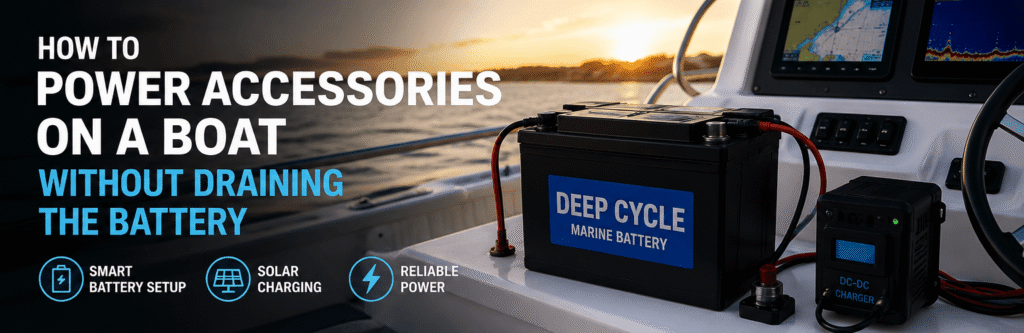
Modern boats rely on a growing number of electrical accessories. GPS systems, fish finders, navigation lights, refrigerators, stereos, mobile chargers, and onboard electronics all improve comfort and safety. However, many boat owners face the same challenge: how to power accessories on a boat without draining the battery.
A dead battery can leave you stranded, prevent your engine from starting, and create safety risks on the water. Fortunately, there are several effective ways to power boat accessories while preserving battery life.
In this guide, you’ll learn the best strategies to keep your accessories running without sacrificing the power needed to start your engine.
Why Boat Batteries Drain So Quickly
Boat batteries often experience significant stress because they are expected to support both engine starting and accessory loads. Unlike cars, many boats spend long periods with electronics running while the engine remains off.
Common power-hungry accessories include:
- Marine refrigerators
- Fish finders
- GPS chartplotters
- Underwater lights
- Sound systems
- Bilge pumps
- USB charging stations
- Radar systems
When these devices draw power continuously, the battery voltage gradually drops. If the battery reaches a critically low level, starting the engine may become impossible.
The Best Way to Power Accessories on a Boat
The most reliable solution is to separate engine starting power from accessory power.
Install a Dual Battery System
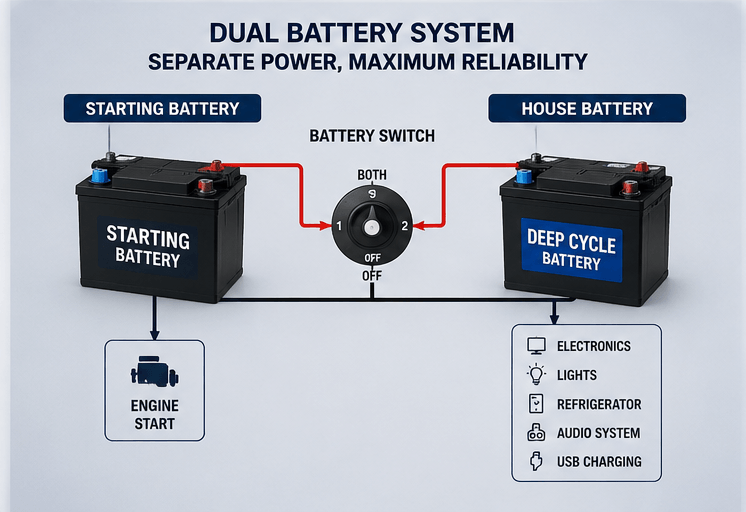
A dual battery setup uses:
- One starting battery
- One deep-cycle house battery
The starting battery is reserved exclusively for engine ignition, while the house battery powers accessories.
Benefits include:
- Increased reliability
- Reduced risk of engine-start failure
- Longer battery lifespan
- Better power management
Many experienced boat owners consider a dual battery system essential for vessels that regularly use electronics.
Use a Battery Switch
A marine battery switch allows you to control which battery powers your boat.
Common positions include:
- Battery 1
- Battery 2
- Both
- Off
This gives you greater control over battery usage and helps prevent accidental discharge of the starting battery.
For maximum protection, many modern systems use automatic charging relays (ACRs) that intelligently distribute charging power between batteries.
Install a Battery Management System (BMS)
A Battery Management System monitors:
- Voltage
- Current draw
- Charging status
- Battery health
Advanced BMS units can automatically disconnect non-essential loads when battery voltage reaches a preset threshold.
This prevents excessive discharge and helps maintain sufficient reserve power for engine starting.
Add Solar Panels for Continuous Charging
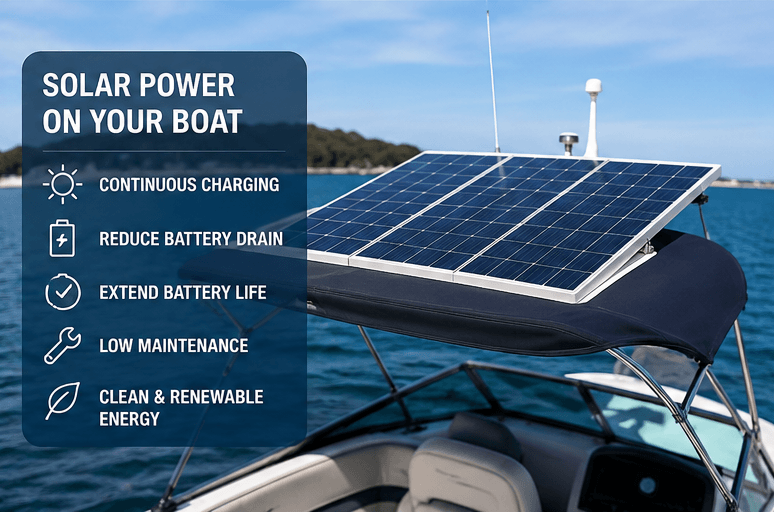
Solar charging has become one of the most efficient ways to power accessories on a boat without draining the battery.
Marine solar panels can continuously replenish energy during daylight hours, reducing dependence on the engine or shore power.
Advantages include:
- Silent operation
- Low maintenance
- Reduced fuel consumption
- Extended battery life
- Renewable energy source
Even a compact solar setup can offset the power consumption of navigation electronics, lighting, and charging devices.
Choose Deep-Cycle Marine Batteries
Not all batteries are designed to handle prolonged accessory loads.
Deep-cycle marine batteries are specifically engineered to:
- Deliver steady power over long periods
- Withstand repeated discharge cycles
- Recover more effectively after use
Compared to standard starting batteries, deep-cycle batteries provide significantly better performance for onboard electronics.
Upgrade to Lithium Marine Batteries
Lithium batteries have become increasingly popular among boat owners seeking greater efficiency.
Benefits include:
- Higher usable capacity
- Faster charging
- Longer lifespan
- Lower weight
- More stable voltage output
Although the initial investment is higher, lithium batteries often provide lower long-term ownership costs.
Monitor Battery Voltage Regularly
One of the simplest ways to avoid battery problems is continuous monitoring.
Recommended voltage levels:
| Battery Status | Voltage |
|---|---|
| Fully Charged | 12.6V – 12.8V |
| Moderate Charge | 12.2V – 12.5V |
| Low Charge | 12.0V – 12.2V |
| Critical Level | Below 12.0V |
Installing a digital battery monitor allows you to identify potential issues before they become serious.
Reduce Unnecessary Power Consumption
Efficient energy use can dramatically extend battery life.
Consider these practical steps:
Switch to LED Lighting
LED marine lights consume significantly less power than traditional incandescent bulbs.
Turn Off Unused Electronics
Many devices continue drawing power even when not actively used.
Use Energy-Efficient Equipment
Modern marine electronics often feature low-power operating modes that reduce battery drain.
Charge Devices Strategically
Recharge phones, tablets, and portable electronics while the engine is running whenever possible.
FAQ
Can I run accessories directly from the starting battery?
While possible, it is not recommended. Continuous accessory use can drain the battery and prevent engine starting. A dedicated house battery provides a safer and more reliable solution.
How long can a boat battery power accessories?
The duration depends on battery capacity, accessory power consumption, battery age, and overall system efficiency. Deep-cycle batteries generally provide longer runtime for marine electronics and onboard accessories.
Are solar panels worth it on a boat?
Yes. Marine solar panels can continuously recharge batteries during daylight hours, helping reduce battery drain and extending the available power for electronics, lighting, and charging devices.
What is the safest battery setup for a boat?
A dual battery system with a starting battery, a deep-cycle house battery, an automatic charging relay (ACR), and a battery monitor is widely considered one of the safest and most reliable configurations.
Final Thoughts
Knowing how to power accessories on a boat without draining the battery is essential for both safety and convenience. The most effective approach combines a dual battery system, deep-cycle batteries, smart battery management, and supplemental charging sources such as solar panels.
By implementing these solutions, boat owners can enjoy reliable power for electronics, navigation equipment, and onboard comforts while ensuring the engine always has enough power to start when needed.