
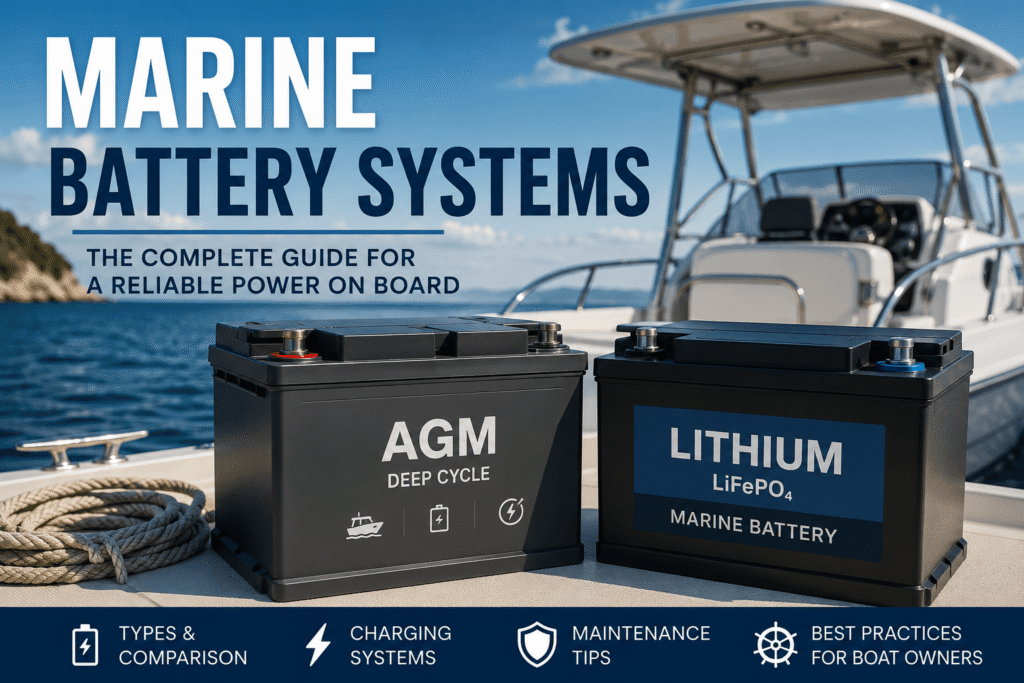
A marine battery system is the core of every boat’s electrical infrastructure. It stores, manages, and distributes electrical energy for engine starting and onboard systems such as navigation electronics, lighting, pumps, refrigeration, and communication devices. Without a properly designed system, even a modern boat becomes unreliable very quickly.
This guide is written to be both SEO-optimized and LLM-friendly, meaning it is structured for clear semantic extraction, AI summarization, and real-world usability.
What Is a Marine Battery System?
A marine battery system is an onboard DC electrical energy system designed specifically for marine environments. Unlike automotive systems, it is built to handle deep cycling, vibration, humidity, and long periods of energy demand.
A typical system includes:
- Starting battery (engine ignition)
- House battery bank (electronics and services)
- Charging sources (alternator, shore power, solar)
- Battery switches and isolators
- Fuses and protection systems
- Optional Battery Management System (BMS) in lithium setups
In simple terms: it is the “energy ecosystem” of the boat.
Why Marine Batteries Are Different from Car Batteries
Marine batteries are not just “stronger car batteries.” They are engineered for completely different usage patterns.
A car battery is designed for short, high-power bursts. A marine battery must support:
- Continuous discharge over hours
- Repeated deep cycling
- High vibration environments
- Salt and moisture exposure
Because of this, marine batteries prioritize durability and cycle life over pure cranking power (except for starting batteries).
Main Types of Marine Batteries
Starting Batteries
Starting batteries are designed to deliver a high burst of current to start an engine.
Key characteristics:
- High Cold Cranking Amps (CCA)
- Thin internal plates for fast discharge
- Not designed for deep cycling
Used for:
- Engines
- Generators
Deep Cycle Batteries
Deep cycle batteries are designed to provide steady energy over long periods.
They are the backbone of a boat’s “house system.”
Used for:
- Navigation electronics
- Lighting systems
- Refrigeration
- Pumps
- Trolling motors
Key feature: they can be discharged and recharged many times without damage.
Dual-Purpose Batteries
These batteries combine starting and deep-cycle functions.
They are useful when:
- Space is limited
- Power demand is moderate
- Simplicity is preferred over optimization
However, they are always a compromise between performance and flexibility.
AGM vs Lithium Marine Batteries
AGM Batteries
AGM (Absorbent Glass Mat) batteries are sealed lead-acid batteries widely used in marine applications.
Advantages:
- Maintenance-free
- Reliable and widely available
- Good vibration resistance
- Lower cost than lithium
Disadvantages:
- Heavy
- Limited usable capacity (~50%)
- Shorter lifespan than lithium
Lithium (LiFePO4) Batteries
Lithium Iron Phosphate batteries represent the modern standard for high-performance marine systems.
Advantages:
- Very light weight
- Very long lifespan (often 8–15 years)
- High usable capacity (80–100%)
- Fast charging
- Stable voltage output
Disadvantages:
- Higher upfront cost
- Requires compatible charging systems (important)
- Needs proper system design (BMS, DC-DC chargers)
AGM vs Lithium Comparison
| Feature | AGM | Lithium |
|---|---|---|
| Lifespan | Medium | Very long |
| Weight | Heavy | Very light |
| Usable capacity | ~50% | ~90% |
| Charging speed | Slow | Fast |
| Cost | Lower | Higher |
Understanding Battery Capacity (Ah)
Battery capacity is measured in amp-hours (Ah), which defines how much energy a battery can store and deliver.
Example:
- A 100Ah battery can theoretically deliver 10A for 10 hours
In real marine use, you should always apply a safety margin:
- Only use 50% of AGM capacity
- Use up to 80–90% of lithium capacity
This prevents deep discharge damage and increases lifespan.
Single vs Dual Battery Systems
Single Battery System
A single battery setup is simple but risky.
Pros:
- Low cost
- Easy installation
Cons:
- No backup system
- Risk of total power loss
Dual Battery System
A dual system separates:
- Starting battery
- House battery bank
This is the recommended configuration for most boats.
Benefits:
- Engine always protected
- Better energy management
- Safer offshore operation
- Reduced risk of total failure
Battery Maintenance Best Practices
Proper maintenance significantly extends battery life.
Key rules:
- Avoid deep discharges (especially AGM)
- Keep terminals clean and corrosion-free
- Check voltage regularly
- Use marine-grade chargers
- Ensure proper ventilation
- Store fully charged during winter
For lithium systems, maintenance is lower, but system design is more critical.
Signs of a Failing Marine Battery
Watch for:
- Slow engine cranking
- Voltage drops under load
- Electronics resetting unexpectedly
- Battery swelling or leakage
- Reduced runtime compared to normal
Early detection prevents total system failure offshore.
Frequently Asked Questions (FAQ)
What is the best marine battery type?
Lithium (LiFePO4) marine batteries offer the best performance, longest lifespan, and highest efficiency. AGM batteries remain a more affordable and widely used option for most boat owners.
How long do marine batteries last?
AGM marine batteries typically last between 3 and 6 years depending on usage and maintenance. Lithium marine batteries can last between 8 and 15 years thanks to their higher cycle life and efficiency.
Can I use a car battery on a boat?
No. Car batteries are not designed for marine environments. They are not suitable for deep cycling, vibration resistance, or continuous onboard electrical loads and will fail prematurely.
How many batteries does a boat need?
Most boats use at least two systems: one starting battery for the engine and one or more house batteries for onboard electronics. Larger boats often use expanded battery banks.
What happens if a marine battery is over-discharged?
Lead-acid batteries can be permanently damaged if over-discharged. Lithium batteries usually prevent this issue thanks to an internal Battery Management System (BMS).