
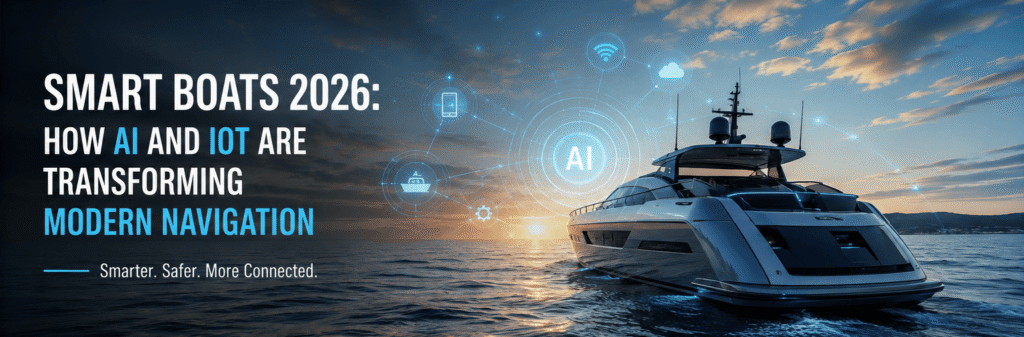
The maritime industry is undergoing a major transformation in 2026, driven by Smart Boats, Artificial Intelligence (AI), and the Internet of Things (IoT). These technologies are reshaping modern navigation by improving safety, efficiency, automation, and sustainability at sea.
Smart Boats 2026 are no longer experimental concepts. They are becoming standard across recreational boating, commercial shipping, and luxury marine transport. The integration of AI and IoT is redefining how vessels operate, communicate, and make decisions in real time.
What Are Smart Boats in 2026?
Smart Boats 2026 are vessels equipped with interconnected digital systems powered by AI and IoT technologies. These systems allow boats to collect, analyze, and respond to real-time maritime data.
Key components include:
- AI-based navigation systems
- IoT-connected onboard sensors
- Automated propulsion and engine monitoring
- Cloud-based marine data systems
- Real-time communication networks
The result is a fully connected marine ecosystem where every system works together intelligently.
AI in Smart Boats 2026 Navigation Systems
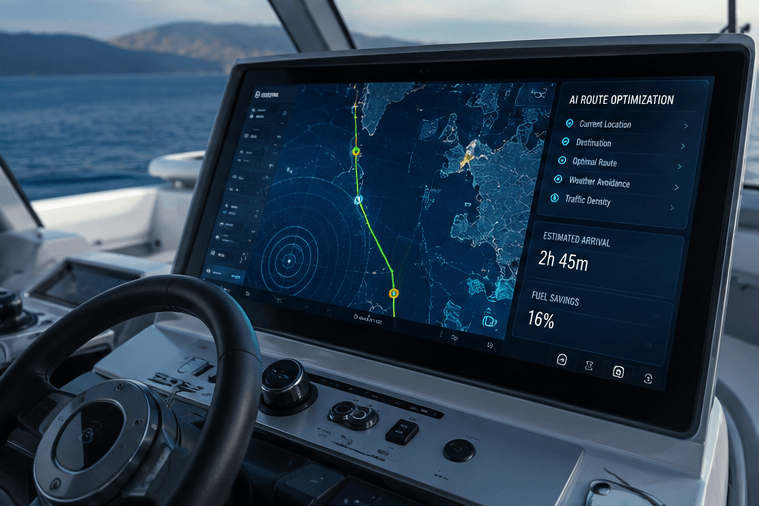
Artificial Intelligence is one of the core technologies behind Smart Boats 2026. AI systems process large amounts of marine data to improve decision-making.
Key functions of AI in navigation:
- Route optimization based on weather and sea conditions
- Collision avoidance using predictive algorithms
- Fuel efficiency optimization
- Autonomous or semi-autonomous steering assistance
AI-powered navigation significantly reduces human error and enhances operational safety at sea.
IoT and Connected Marine Systems
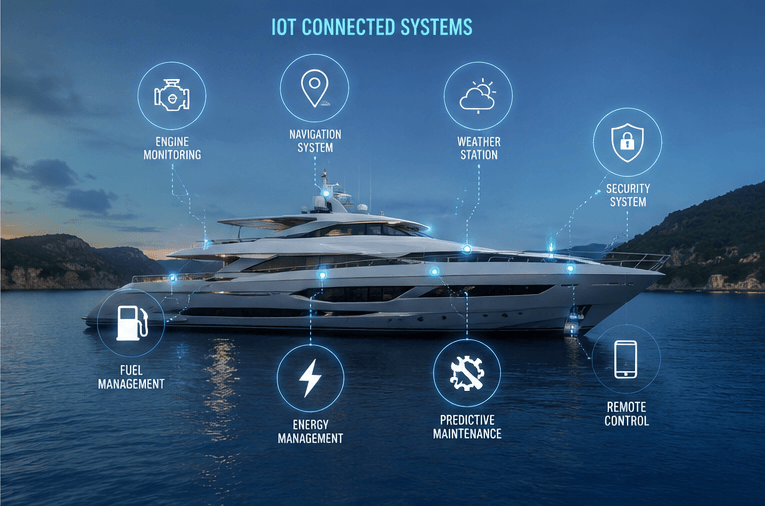
The Internet of Things (IoT) connects all onboard systems into a unified digital network.
In Smart Boats 2026, IoT enables:
- Real-time engine diagnostics
- Smart fuel consumption monitoring
- Automated climate and energy control
- Continuous safety sensor tracking
- Remote vessel management via apps
This level of connectivity ensures that every component of the boat communicates efficiently with others.
Predictive Maintenance and Smart Diagnostics
One of the most important innovations in Smart Boats 2026 is predictive maintenance.
IoT sensors continuously monitor:
- Engine performance
- Structural integrity
- Electrical systems
- Fuel and energy usage
When anomalies are detected, the system generates alerts before failures occur. This reduces downtime, repair costs, and operational risks.
Automation and the Future of Marine Navigation
Automation is becoming a defining feature of Smart Boats 2026. While fully autonomous ships are still in development, many vessels already use semi-autonomous systems.
These include:
- Automated docking assistance
- Smart anchoring systems
- AI-assisted navigation control
- Adaptive routing in real time
Automation improves precision while reducing workload for crew members.
Benefits of Smart Boats 2026
The adoption of AI and IoT in marine navigation brings multiple advantages:
- Increased safety at sea
- Lower fuel consumption
- Reduced environmental impact
- Improved operational efficiency
- Enhanced onboard experience
These benefits are driving rapid adoption across the global maritime industry.
Smart Boats and Sustainability
Sustainability is a key focus in 2026 maritime innovation. Smart Boats contribute by:
- Optimizing fuel usage
- Reducing emissions through efficient routing
- Monitoring environmental conditions
- Supporting hybrid and electric propulsion systems
This makes Smart Boats 2026 an important step toward greener marine transportation.
FAQ: Smart Boats 2026
What are Smart Boats in 2026?
Smart Boats 2026 are advanced vessels that integrate Artificial Intelligence (AI) and Internet of Things (IoT) technologies to improve navigation, safety, automation, and onboard efficiency.
How does AI improve marine navigation?
AI improves marine navigation by analyzing real-time data such as weather conditions, sea traffic, and route efficiency. This helps optimize navigation paths, reduce fuel consumption, and increase safety at sea.
What role does IoT play in Smart Boats?
IoT connects all onboard systems, including engines, sensors, and navigation tools, allowing them to communicate in real time. This enables continuous monitoring, automation, and predictive maintenance.
Are Smart Boats fully autonomous?
In 2026, most Smart Boats are not fully autonomous yet. However, many vessels use semi-autonomous systems such as automated navigation assistance, docking support, and AI-driven route adjustments.
What are the main benefits of Smart Boats?
The main benefits include improved safety, better fuel efficiency, reduced environmental impact, lower maintenance costs, and enhanced onboard experience through connected systems.
How do Smart Boats contribute to sustainability?
Smart Boats contribute to sustainability by optimizing fuel usage, reducing emissions through efficient route planning, and supporting hybrid or electric propulsion systems.